A litter box needs room for your cat to turn, an entrance they can manage and a spot they can reach comfortably. Before comparing styles, measure your cat and the inside of the box. Leave room around it for entering, leaving and cleaning.
A compact footprint can be helpful in a small home. It should not come at the expense of the space your cat uses.
The quick fit check
Write down these five things before shopping:
- Your cat’s length from nose to the base of the tail
- The box’s usable interior, where your cat actually stands and turns
- The entrance width, height and threshold to step over
- The complete outside dimensions, including anything that projects beyond the tray
- The space needed to approach the entrance, scoop the box and remove it for cleaning
If a listing gives only outside dimensions, ask for the inside measurements. The advertised length may include space your cat cannot use.
Use the free litter box space planner in your browser to record measurements and check the room before buying. Prefer paper? Download the printable planner (PDF, 2 pages).
1. Start with your cat’s length
AAFP and ISFM guidelines on house soiling recommend a rectangular box about 1.5 times the cat’s length, measured from the nose to the base of the tail. The same guidance notes that many commercial boxes are small and identifies larger trays or suitable storage containers as possible alternatives. Read the AAFP/ISFM guidelines.
Measure while your cat is standing naturally, without holding them stretched out. If they dislike the tape measure, stop and try another calm moment. Exclude the tail itself.
For a cat measuring 18 inches, the starting target for box length is 27 inches: 18 × 1.5. Check width, entry and headroom too.
None of the eight listings in our dimensions comparison confirms a usable interior 27 inches long for that cat measuring 18 inches. The largest published length for the litter area or inside bottom is 25 inches, for Shirley K’s Senior Cat Litter Box; its top outside length is 30 inches. For this cat, keep looking beyond the comparison. Ask for inside length and width at the litter floor, then check entry, headroom and room fit.
Length alone cannot tell you whether a box fits. A long, narrow tray may still be cramped. Watch whether your cat can enter fully, turn and position themselves without crowding.
Size labels such as “large” and “jumbo” are useful for identifying a variant. They are not a substitute for its measurements.
2. Check how much room your cat has inside
The number on a product page may describe the space on your floor or the space inside the tray. Here is what to look for:
- Outside dimensions: how much room the product occupies
- Base dimensions: the bottom footprint; this may be smaller than the rim and may describe the outside rather than the inside
- Interior dimensions: space within the walls, sometimes measured at the top rather than the floor
- Litter area dimensions: the maker’s stated space for litter, where available
These labels should stay separate. Tapered sides, liners, a storage caddy and the shape of a cover can change how much space remains available.
The tuft + paw Cove shows why this matters. Its US product page lists an outside footprint of 26 by 16 inches and a litter area of 20 by 14 inches. The length of 26 inches includes space the cat cannot use for litter. Cove technical details. We may earn a commission if you buy through this link.
Our dimensions comparison keeps these fields separate and marks missing information as unknown. If an inside measurement is missing, the listing leaves the question of fit unanswered.
3. Check the entrance separately
A box can have a roomy interior and still be awkward to enter. Look for:
- The opening’s width and height
- The threshold’s height above the floor
- Whether entry requires stepping, climbing or jumping
- Whether a flap, rim or hood narrows the route

Overall wall height does not tell you the height of a lowered entrance. Likewise, “front entry” does not necessarily mean a low threshold.
How low is the KittyGoHere Large entrance?
The KittyGoHere Senior Cat Litter Box Large has a published entrance height of 3 inches. For the Black model, the maker’s dimension diagram also shows an entrance about 11 inches wide and a highest wall about 5 inches tall. The diagram marks its dimensions as approximate. This gives you a concrete entrance to compare with your current tray; 3 inches is not a universal target for every cat.
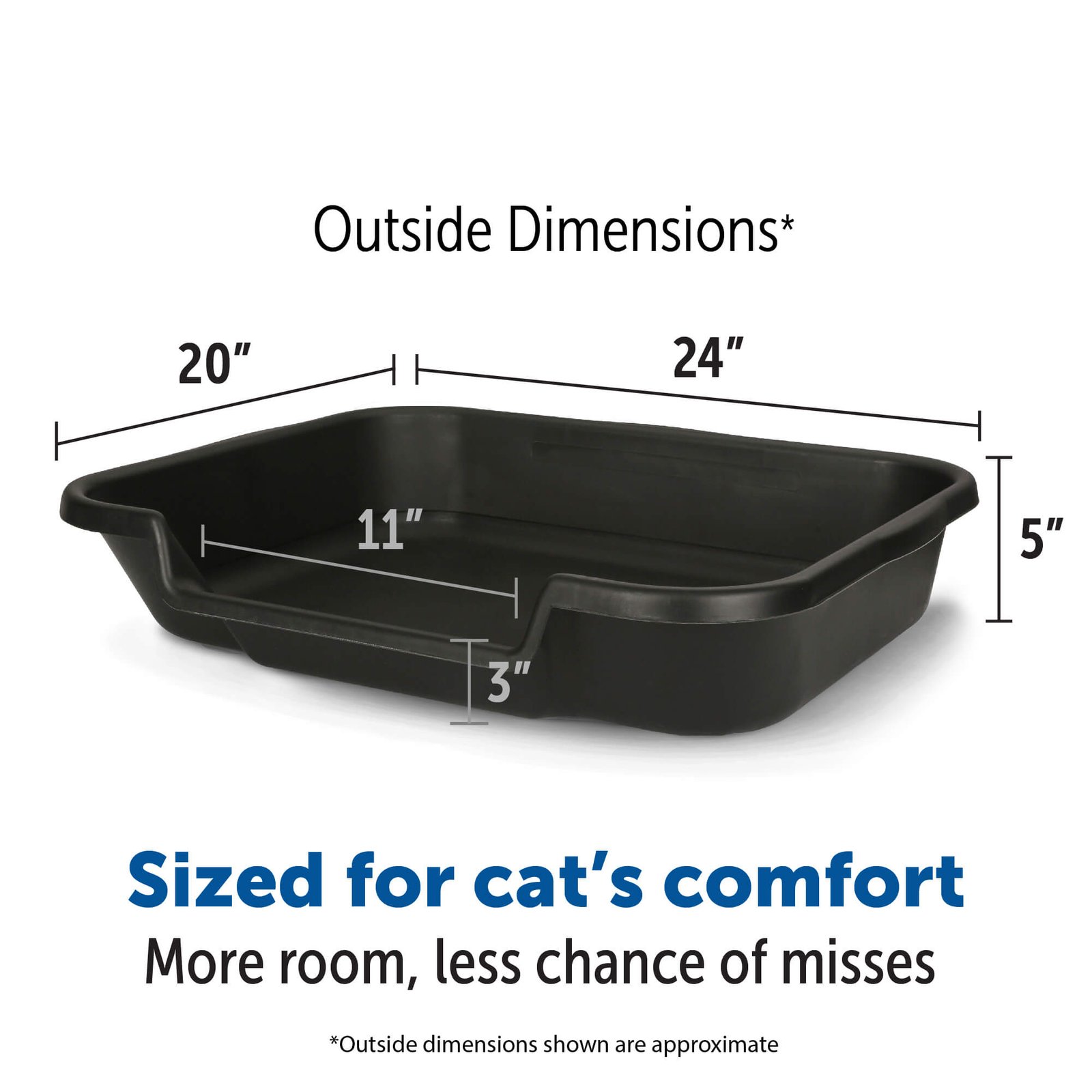
The outside footprint is about 20 inches from front to back and 24 inches from left to right. That is the room the box occupies, not a confirmed 20 by 24 inch floor for your cat. We did not find usable inside bottom measurements in the current product page or its diagrams.
Before buying, check both questions: can your cat manage the entrance, and is the usable inside space large enough? Ask the maker for the missing inside measurements rather than treating “Large” or a cat weight suggestion as proof of fit. Black, Single option checked October 18, 2026. This is a published specification example; we have not measured or tested the box.
FelineVMA’s guidance on senior care suggests considering a box with a lower entrance to make access easier for older cats. It also stresses that changes in a cat’s routine or movement can be signs of pain. If your cat is newly hesitant to climb in, misses the box, or changes toileting habits, contact your veterinarian rather than assuming a different product will solve it. Senior cat care guidance. Straining to urinate with little or no urine needs immediate veterinary attention.
For a cat with limited mobility, ask your veterinarian what entry arrangement would be easiest for them.
4. Measure the whole setup in your room
Use a tape measure and a simple sketch. If it is safe for your floor, removable painter’s tape can help you picture the proposed footprint; test it inconspicuously first and remove it when finished.
Mark the box’s outside rectangle, then check:
- Approach: can your cat reach the entrance without squeezing behind a door or another object?
- Exit: is there an unobstructed way back into the room?
- Household doors: will a bathroom, closet or cabinet door hit the box or block access?
- Cleaning: can you reach the far corners with a scoop?
- Lid movement: can a lid open fully or be lifted off?
- Removal: can the full tray come out without tilting into a wall or dismantling the furniture?
A shelf that clears the closed lid may still stop you opening it. A cabinet opening can be narrower than the cabinet’s interior. Measure the narrowest point the tray has to pass through.
The extra space you need depends on the cat, entrance direction, lid mechanism, nearby furniture and how you clean. If the manufacturer publishes required clearance, follow it. Otherwise, check that each part of the routine works in the space you have.
If you are considering an automatic box, our cleaning access guide for the Litter-Robot 4 and white PetSafe SmartSpin follows the drawer, cover and chamber removal paths, with the limits of the available clearance guidance.
5. Choose a location before choosing an enclosure
Professional caregiver guidance recommends quiet locations away from food and water, with access that another animal cannot easily block. It suggests one box per cat plus an extra, distributed around the home, and a box on each level of a home with several levels. Placing several boxes together does not provide the same spread of options. AAFP caregiver guidance.
In a small apartment, start by listing the plausible locations, even the ones you would prefer not to see. Compare them for access, interruptions and cleaning before buying furniture to hide the tray. Our placement guide for small apartments walks through studios, bathrooms, hallways and compromises in homes with several cats.
For two cats, draw both cats’ routes. A box at the end of a narrow passage may technically fit while leaving one cat dependent on getting past the other. FelineVMA’s guidance on environmental needs emphasizes multiple, separated resources so cats have choices about where to eat, rest, play and toilet. Environmental needs at home.
A furniture enclosure adds another doorway and more measurements to check. Measure the tray, the cabinet interior and the path through it. Even if everything fits, your cat may not be comfortable using the enclosure.
For a worked enclosure example, compare Litter Loo Standard and Refined Feline Deluxe Large. The guide separates cabinet dimensions, cat entry and tray removal, using the Cubby footprint to show what nominal clearance can and cannot establish.
6. Compare open and covered boxes
An open tray makes it straightforward to see the available space. With a covered box, check usable headroom and the entrance as well as the tray. The roofline may reduce room near the edges.
Think through maintenance in the actual location. Does the cover detach? Where would you put it while scooping? Can you clean the corners and seams? Will you need to keep buying liners or replacement filters?
Preference can vary between cats. The AAFP’s practice guidance recognizes that cats may prefer different litter box types, while noting a general preference for uncovered boxes. Preserve an option your cat already uses comfortably while assessing a change, and seek veterinary advice if toileting problems appear. AAFP practice guidance.
For the choice between a roof, open tray and high sides, see our covered vs open litter-box guide. It separates individual preference from practical access and cleaning tradeoffs.
7. Resolve uncertain measurements before buying
Product pages sometimes give conflicting measurements. On the Modkat XL page checked for this guide, one section lists the width as 16.3 inches and another gives 16.5 inches. We have not resolved that difference. If your available space is tight, neither figure should be treated as a guaranteed fit. Modkat XL specifications.
Send the seller a specific question:
“Could you confirm the current model’s maximum outside length and width, usable inside length and width at the litter floor, entrance threshold height, and space needed to open or remove the lid?”
Save the reply with the exact model and variant. Also read the seller’s return conditions before using the product; a return window does not necessarily allow returns after a cat has used a box.
Before you buy
A better location, more room around an existing tray, or a different cleaning arrangement may solve the practical problem without a new purchase. If you do need a box, compare the simplest suitable option first.
Fill in these notes for the exact model and variant you are considering:
- My cat’s length from nose to the base of the tail: ___; multiplied by 1.5, the starting target for box length is: ___
- Verified usable inside length and width: ___; source or manufacturer reply: ___
- Entrance width, height and threshold to step over: ___; any access concern for my cat: ___
- Planned location: ___; approach, exit, scooping, lid movement and tray removal checked: ___
- Questions still unanswered: ___; ongoing supplies and return restrictions checked: ___
If a confirmed measurement falls short of your starting target, keep looking. If a measurement that could change your decision is missing, ask the manufacturer before buying. These checks can rule out poor fits, but your cat’s comfort still matters.
Before spending, check that your cat can use the box comfortably and that you can keep it accessible and clean.
How we researched this. We checked manufacturer specifications and published veterinary guidance to build this guide. Product comparisons are based on published information rather than hands on testing or our own measurements. Sources checked September 30, 2026. Cove specifications rechecked November 2, 2026. Its product link above may earn us a commission; other source links do not.